What is a Spiky Profile and Why Should Education Departments Care?
In schools, we often talk about students as if their abilities are smooth and evenly distributed. A child is reading at Year 4, maths at Year 5, and behaving at some kind of average. But for many neurodivergent learners, that picture is misleading. Their abilities look more like a jagged mountain range: very high peaks in some areas and deep valleys in others.
This is what educators call a spiky profile.
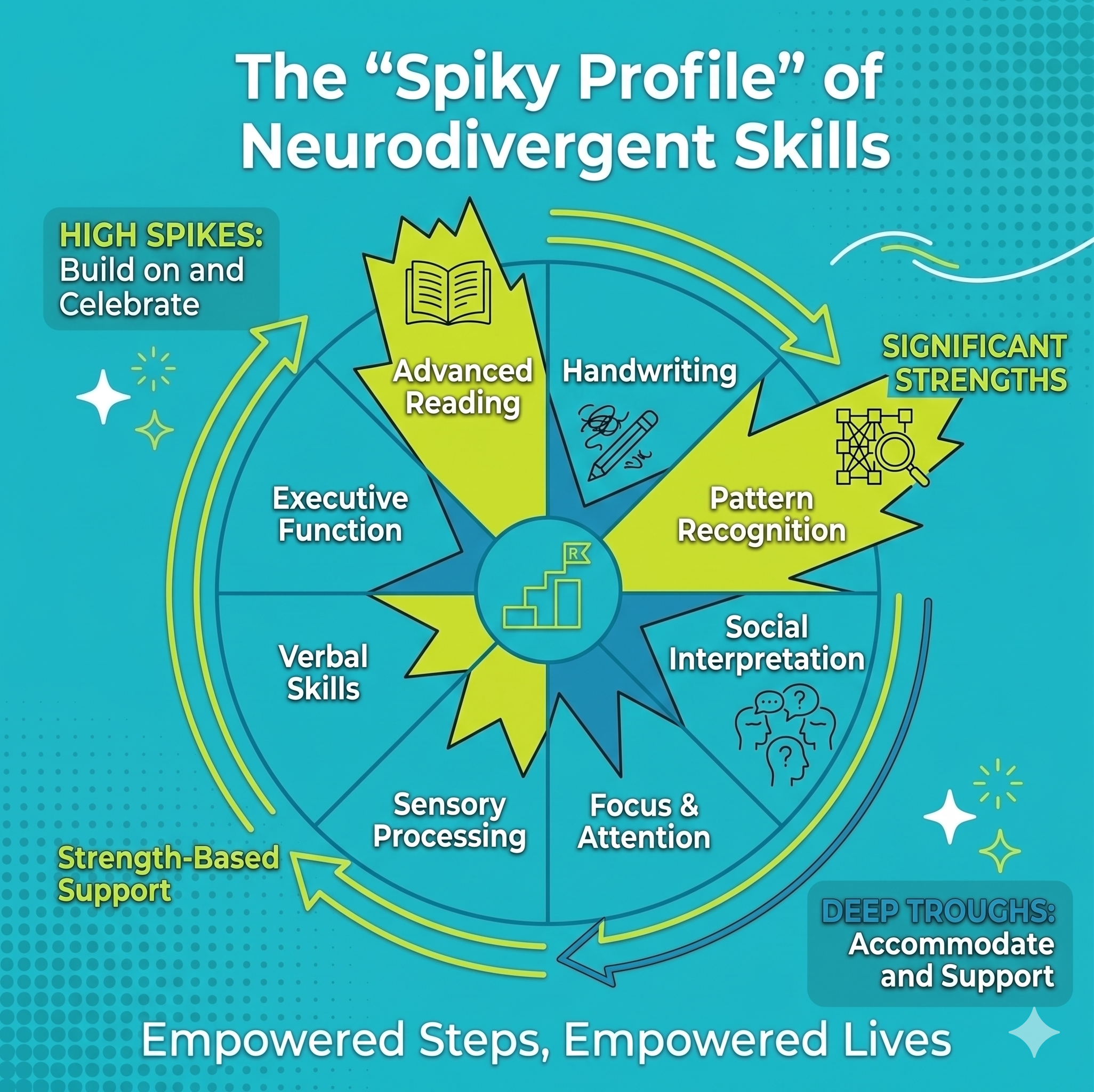
A spiky profile is a pattern of uneven strengths and needs across different cognitive, learning, or functional areas. In practice, it means a student might be very strong in one domain, such as verbal reasoning, pattern recognition, or visual thinking, while needing significant support in another, such as processing speed, writing, working memory, or social communication. For neurodivergent learners, this variability is common enough that it should be treated as a core educational fact rather than a side note.
A spiky profile is a pattern of uneven strengths and needs across different cognitive, learning, or functional areas. In practice, it means a student might be very strong in one domain, such as verbal reasoning, pattern recognition, or visual thinking, while needing significant support in another, such as processing speed, writing, working memory, or social communication.
For neurodivergent learners, this variability is common enough that it should be treated as a core educational fact rather than a side note.
Why schools should care
Education departments should care because spiky profiles are one of the main reasons a "same support for all" model fails. A student can look highly capable in one classroom task and then appear to "underperform" in another, not because they are inconsistent in motivation, but because their profile is uneven.
If schools only read grades or behaviour as broad indicators, they can miss genuine strengths, misinterpret stress responses, and set expectations that are either too low or too high. This mismatch is not just frustrating for students; it has real consequences.
When expectations are too high in a weak area and too low in a strong area, students can internalise a sense that they are "failing" rather than seeing that the system is not built for how they think, feel, move, or learn. Over time, this can impact wellbeing, self-perception, attendance, and engagement with learning.
What the research says
Research on autistic cognition shows a meaningful pattern of variability across domains, with strengths in some areas and relative weaknesses in others.
Studies also show that autistic strengths and interests can be harnessed to support wellbeing, academic progress, and later professional success, but only when support is tailored to the person's actual profile.
In school settings, that means teachers need to understand the whole learner rather than rely on a single average score or diagnosis label.
Importantly, research challenges the idea that neurodevelopmental conditions are defined by global deficits. Instead, cognitive profiles often show distinctive patterns of peaks and valleys. This is not just about autism; similar uneven profiles are common in ADHD, dyslexia, dyspraxia, and other neurodivergent conditions. The educational implication is the same: support must be individualised, not standardised.
The practical school impact
Spiky profiles matter because they influence how students learn, respond, and participate. A child who can explain ideas brilliantly may still struggle to write them down under time pressure, and a student with strong memory may still need help with transitions, organisation, or sensory regulation. When educators recognise this pattern, they can separate skill from effort, which leads to more accurate planning, fairer assessment, and better classroom support.
For example, a student might:
Understand complex mathematical concepts but struggle to complete written calculations in a timed test.
Have exceptional verbal reasoning but find writing essays exhausting and slow.
Show brilliant problem-solving skills but find social interactions unpredictable and confusing.
Demonstrate strong memory for facts but struggle with organisation and planning.
These are not contradictions.
They are spiky profiles in action.
Why this matters for policy
For education departments, spiky profiles are a policy issue because they challenge blunt categories and one-size-fits-all reporting. Systems built around averages often miss students whose strengths and needs do not line up neatly with grade expectations.
That can lead to delayed adjustments, under-identification of support needs, or misplaced behaviour concerns when the real issue is task design, processing load, or sensory environment.
When policy focuses on averages, it risks treating spiky profiles as "exceptions" rather than as a normal part of human variation. That approach is increasingly out of step with current research on neurodiversity, which emphasises variation, strengths, and the need for flexible, context-sensitive support.
What schools should do differently
Schools should build support around the student's actual profile, not around assumptions. Practical responses include:
Visual supports and explicit instructions to reduce cognitive load.
Flexible ways to show learning, so students can use strengths (e.g., oral responses, drawings, models) rather than being forced into one mode (e.g., written essays under time pressure).
Extra processing time for tasks that require writing, planning, or complex reasoning.
Sensory-informed classrooms that reduce noise, glare, and unexpected demands.
Strength-based planning that identifies what the student excels in and uses that as a doorway to learning, rather than focusing only on deficits.
A new question for schools
The key question for schools is not "Why is this student so inconsistent?" but rather "What does this student's spiky profile tell us about how they learn, and how can we design around that?".
When educators adopt this question, they shift from a deficit model to a design model, which is much closer to the current research and to the kind of work that supports real, sustainable change.
Why Willful Steps
Willful Steps is positioned to help schools translate the latest neurodiversity research into practical, classroom-ready action. Our school training is designed for educators who want to understand neurodivergent student profiles, move beyond behaviour-only interpretations, and align classroom practice with a neurodiversity-affirming philosophy.
At Willful Steps, we work with individuals, leaders, partners, and parents to provide personalised neurodiversity coaching and training, helping schools align with the most up-to-date research in neurodiversity. That matters because effective support is not just about awareness; it is about changing environments, communication, and expectations so students can actually access learning.
Our approach is grounded in current research on spiky profiles, autistic strengths, and the importance of tailored support.
We help schools move from asking "Why can't this student do what everyone else does?" to asking "How can we design learning so this student can use their strengths and get the support they need?"
What schools can do next
If your school wants to align with the latest research on spiky profiles and neurodiversity, Willful Steps can help you:
Build teacher understanding of spiky profiles and their implications for classroom practice.
Develop strength-based planning that uses student strengths as a doorway to learning.
Create inclusive environments, communication practices, and assessment strategies that support neurodivergent learners.
Contact Willful Steps to discuss school training aligned with the most up-to-date research in neurodiversity. Together, we can help neurodivergent students thrive while equipping your school to turn neurodiversity into a genuine competitive advantage.
References
Exceptional Individuals, 'Spiky Profile: What is It and Who is it for?', Exceptional Individuals (2026), <https://exceptionalindividuals.com/candidates/neurodiversity-resources/spiky-profile/>.
Creased Puddle, 'What is the Spiky Profile?', Creased Puddle (2018), <https://www.creasedpuddle.co.uk/resource/what-is-the-spiky-profile/>.
Christina MacNamara, 'Understanding Spiky Cognitive Profiles in Neurodivergence', Christina MacNamara (2025), <https://christinamacnamara.com/spiky-cognitive-profiles-in-neurodivergent-people/>.
Frontiers in Psychology, 'Interests and Strengths in Autism, Useful but Misunderstood: A Pragmatic Case-Study' (2020), <https://www.frontiersin.org/journals/psychology/articles/10.3389/fpsyg.2020.569339/full>.
Australian Public Service Commission, 'Autism in the workplace', APSC (2024), <https://www.apsc.gov.au/working-aps/diversity-and-inclusion/diversity-inclusion-news/autism-workplace>.
Bright Future Training, 'Beyond the Label – Understanding the Spiky Spectrum of Neurodivergence Across School and Work', Bright Future Training (2025), <https://www.brightfuturetraining.co.uk/blog/editorial-beyond-the-label-understanding-the-spiky-spectrum-of-neurodivergence-across-school-and-work/>.
Paula Ratcliffe and others, 'The Survey of Autistic Strengths, Skills, and Interests', PMC (2023), <https://pmc.ncbi.nlm.nih.gov/articles/PMC10587489/>.
Drexel University, 'New Research Recommendations for Supporting Autistic Adults to Ensure Their Communication Needs Are Met', Drexel (2025), <https://drexel.edu/news/archive/2025/August/New-Research-Recommendations-for-Supporting-Autistic-Adults-to-Ensure-Their-Communic/>.
Willful Steps, 'The Willful Steps Philosophy', Willful Steps, <https://willfulsteps.com/our-philosophy/>.